

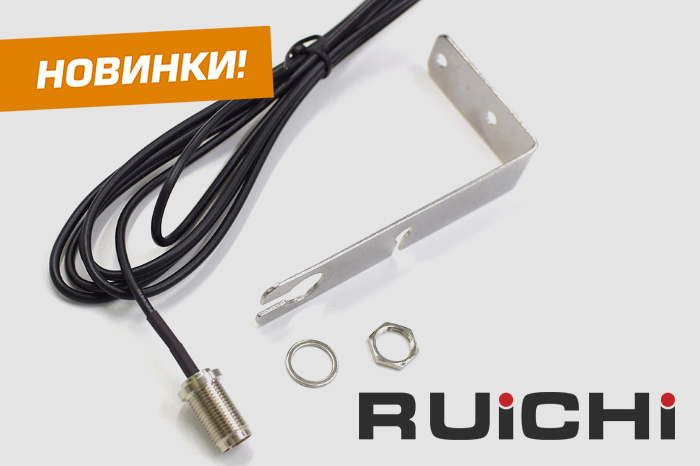
New in the catalog! RUICHI 433 and 868 MHz antennas.
Modern technical equipment, as well as continuous technology improvement, allows RUICHI to produce inexpensive, energy-efficient sub-GHz antennas for operation in the 868 and 433 MHz bands.
During the design of a wireless system, special attention should be paid to the choice of frequency range. This is because throughput, communication range, and power consumption depend on this parameter.
The most common wireless communication standards, namely ZigBee, Wi-Fi, and Bluetooth, operate in the 2.4 GHz range; however, it is not ideal for designing all wireless systems.
Sub-GHz or “proprietary protocols” have many advantages:
- longer communication range;
- lower financial costs;
- high communication quality;
- low power consumption.
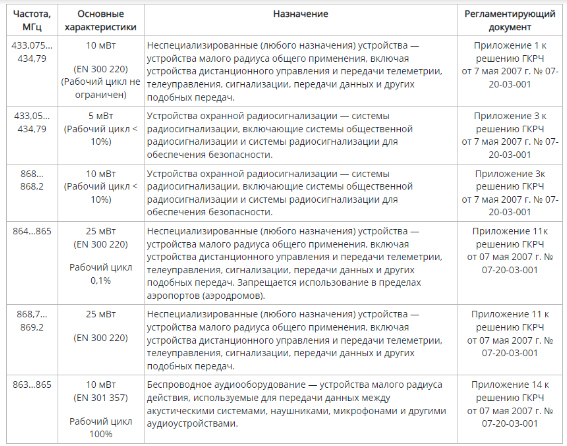
In Russia there are 2 sub-GHz frequency ranges. Their special feature is the possibility of license-free use of radio transmission devices. These are the 868 and 433 MHz ranges. To use radio transmitting devices, there is no need for registration or obtaining specific permits. But the devices themselves must comply with the technical requirements approved by GKRCh.
Table 1 – technical parameters and operating features of devices for wireless information transmission at frequencies 868 and 433:
If we compare transceivers operating in the 433 and 868 ranges with radio transmitting devices operating in the 2.4 GHz range, they are simple in terms of design and use and work effectively not only outdoors but also indoors. The main parameters should be considered in more detail.
Dimensions
If we talk about choosing the frequency range for the operation of the transmitting and receiving device, it does not affect the dimensions. But we must not forget about the length of the antenna itself, on whose dimensions the wavelength depends. Because of this, sub-GHz devices are equipped with antennas that are longer than standard wireless communication devices.
According to the formula presented above, the antenna length for devices operating in the 868 MHz range is 8.2 cm, for 433 – 17.3 cm. At the same time, we must not forget that for receivers/transmitters of the 433 range there are miniature antennas, but they are highly specialized and have low efficiency.
Communication range
The communication range of devices operating in the sub-GHz range is significantly higher than that of devices that support 2.4 GHz. This is due to several factors.
First, the 868 and 433 MHz ranges allow the use of a narrowed receiver bandwidth. Thanks to this, it becomes possible to increase sensitivity to 125 dBm.
Second, if the transceiver is installed indoors, when the signal passes through obstacles, the signal attenuates significantly less than in the 2.4 GHz range. The difference is especially evident in reinforced concrete buildings.
Third, radio waves in the 433 and 868 MHz ranges have greater diffraction. This means that they bend around various obstacles better than waves in the 2.4 GHz range.
Power consumption
This parameter fully corresponds to the rule – the higher the operating frequency, the greater the power consumption. In sub-GHz transceivers, power consumption is in the range from 10 to 20 mA (depending on the selected model).
To reduce power consumption, RUICHI has developed and continues to modernize modern ICs, with the help of which the device transitions from sleep to operating state in a few microseconds.
For longer operation of built-in batteries, modern transceivers periodically “sleep” for seconds or minutes. This significantly reduces power consumption, but a small delay appears in terms of instant communication availability.
Interference resistance
A huge number of various devices operate in the 2.4 GHz range. This refers to Wi-Fi routers, smartphones, microwave ovens, and other equipment. At the same time, most of them operate around the clock at maximum power. This is precisely why this range is subject to serious interference.
As for devices operating in the 433 MHz range, the interference situation here is less tense, since most such devices are switched on for a certain time and do not operate continuously.
The best range in terms of absence of interference is 868 MHz. This is due to the fact that in the Russian Federation they have been used for a shorter period of time than the previous ones.
Software complexity
In addition to ICs and a set of electronic components, all modern transceivers have software with the help of which the radio protocol is implemented. The 2.4 GHz range is characterized by the use of standard protocol stacks. Technically, they are quite complex and require the use of a microcontroller with a large amount of flash memory for efficient operation. For example, for Wi-Fi routers, a microcontroller with a memory capacity from 1 MB is required.
As for ensuring the operability of proprietary protocols used in sub-GHz ranges, a few KB are sufficient here.
In addition to memory capacity, it is important to remember that standard protocols require high computing power.
In terms of time spent on development, proprietary protocols also lead. For consumer electronics, standard protocols are more in demand due to their versatility.
Conclusion
Modern technical equipment, as well as the improvement of technologies, allows RUICHI to produce inexpensive, energy-efficient sub-GHz antennas for operation with the 868 and 433 MHz ranges. They largely outperform devices in the 2.4 GHz range in urban environments and when used indoors. Thanks to a wide assortment, it is possible to select an antenna for any wireless communication device to solve specific tasks. Their use is especially advantageous in industrial telemetry systems.