

New in the catalog! RUICHI FAKRA series RF connectors.
FAKRA connectors from RUICHI are used as standard interfaces for high-frequency telematics applications in vehicles, where safety is the number one priority.
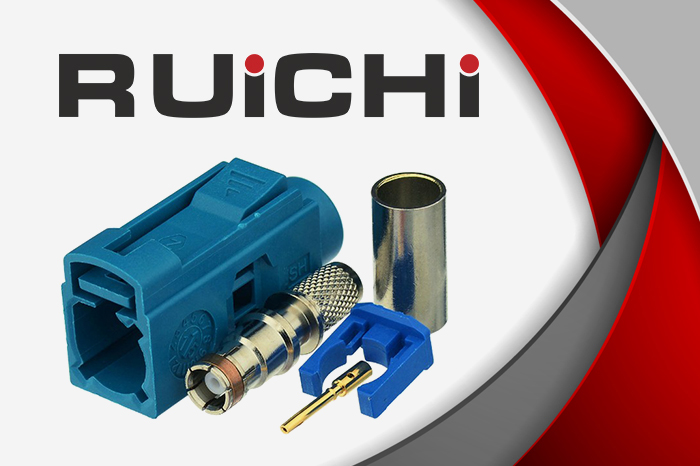
FAKRA is an abbreviation of "FAchKReis Automobile" (Automobile Expert Group). FAKRA radio-frequency (RF) connectors were created in Germany for the "Fachkreis Automobile". The connector standard was developed by a subcommittee within the German committee of automobile manufacturers. It has been adopted by major automobile manufacturers and suppliers of automotive communication systems. Today FAKRA connectors are used throughout the automotive industry, including GPS systems, ERA-GLONASS, satellite radio receivers, in-car Internet access, engine management systems, GSM antennas, etc.
Advantages of RUICHI FAKRA standard connectors:
- high reliability;
- easy "termination" of RF cable;
- durability and ease of operation;
- color coding;
- unique additional "key" system on the connectors.
RUICHI FAKRA series RF connectors, compatible with industry standards, are designed to meet the strict mechanical and environmental requirements of the automotive industry. Delivering maximum electrical and mechanical performance, these high-quality FAKRA connectors feature plastic housings with special color coding in accordance with the FAKRA industry coding standard. FAKRA connectors are available in different colors and with different guides. The latter serve as a "key", which eliminates the possibility of incorrect connection of one system to another.
FAKRA type connectors from manufacturer RUICHI are used as standard interfaces for RF telematics applications in vehicles where safety is the number one priority. For example, in autonomous driving and driver assistance systems, where precise positioning, continuous route calculation, and object detection and classification are required.
Therefore, large volumes of data from multiple cameras, various sensors and navigation sources must be combined and transmitted in real time. This can only be achieved by using RF cables with the required characteristic impedance to match the transmitter-receiver communication line.
- RUICHI FAKRA TYPE Z-J series RF connector (socket) for connecting GPS/GLONASS equipment, crimp, for RG174/RG316 cable, 5000 MΩ, -40…+105 °C, housing color blue (RAL 5021)
- RUICHI FAKRA TYPE C-JR series RF connector (socket) for connecting GPS/GLONASS equipment, crimp, for RG174/RG316 cable, 5000 MΩ, -40…+105 °C, housing color blue (RAL 5005)
- RUICHI FAKRA TYPE Z-P series RF connector (plug) for connecting GPS/GLONASS equipment, crimp, for RG174/RG316 cable, 5000 MΩ, -40…+105 °C, housing color blue (RAL 5021)
- RUICHI FAKRA TYPE C-PB series RF connector (plug) for connecting GPS/GLONASS equipment, crimp, for RG174/RG316 cable, 5000 MΩ, -40…+105 °C, housing color blue (RAL 5005)
- RUICHI FAKRA TYPE D-J series RF connector (socket) for connecting GSM equipment, crimp, for RG174/RG316 cable, 5000 MΩ, -40…+105 °C, housing color violet (RAL 4004)
- RUICHI FAKRA TYPE D-P series RF connector (plug) for connecting GSM equipment, crimp, for RG174/RG316 cable, 5000 MΩ, -40…+105 °C, housing color violet (RAL 4004)
- RUICHI FAKRA TYPE Z-J series universal RF connector (socket) for connecting any equipment, crimp, for RG174/RG316 cable, 5000 MΩ, -40…+105 °C, housing color turquoise (RAL 5021)
- RUICHI FAKRA TYPE Z2-P/C-J1.5 series universal RF connector (plug), waterproof, for connecting any equipment, crimp, for RG174/RG316 cable, 5000 MΩ, -40…+105 °C, housing color turquoise (RAL 5021)